
1. Introduction
The modern application landscape—shaped by cloud-native architectures, microservices, and a heavy reliance on open-source components—has transformed the software supply chain into a primary frontier of cyber risk. A typical enterprise application now depends on thousands of third-party libraries, container images, and external services, each representing a potential vector for malicious code injection, dependency confusion, or credential theft. According to industry reports, supply chain attacks grew by more than 600% between 2020 and 2023, affecting organizations across all sectors (Sonatype, 2023).
Simultaneously, the widespread adoption of “You Build It, You Run It” has placed enormous operational responsibility on development teams. Engineers are now expected to master not only application logic but also container hardening, secret management, compliance frameworks, and runtime security monitoring. This expansion of duty, without corresponding investment in tooling and abstraction, has led directly to developer burnout, context switching, and “security fatigue”—a state where security steps are seen as roadblocks rather than safeguards.
Platform Engineering has emerged as a direct response to this complexity. By building integrated, self-service internal platforms, organizations can abstract away the undifferentiated heavy lifting of software delivery while embedding governance, security, and compliance into pre-configured “golden paths.” The central hypothesis of this research is that security embedded within the platform becomes an invisible enabler: it reduces the attack surface of the supply chain, eliminates manual error, and makes the most secure path the easiest path for developers. This paper examines the mechanisms through which Platform Engineering achieves these goals, supported by architectural insights, industry trends, and measurable outcomes.
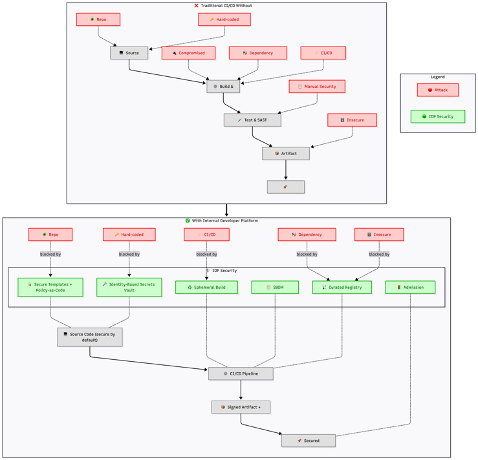
Figure 1.
Description: A layered diagram showing a typical CI/CD pipeline with arrows pointing to potential attack points—source code repository poisoning, compromised build plugins, dependency confusion, CI/CD misconfiguration, insecure artifact registries, and hard-coded secrets. The bottom layer depicts the traditional “gated” security checks, while an overlay shows how an IDP collapses these vectors into an automated, controlled plane.
2. The Friction Paradox: Security vs. Developer Velocity
Historically, security has been implemented as a series of stage-gate reviews—manual penetration tests, ticketed approvals, and out-of-band compliance audits. While well-intentioned, such models directly conflict with the high deployment cadence demanded by modern businesses. Research from the State of DevOps reports shows that elite performers deploy multiple times per day and maintain lead times of less than one hour; introducing manual security gates can increase deployment lead time by orders of magnitude, creating a “friction paradox” where tighter security controls slow delivery to the point that developers bypass them entirely.
The cognitive load imposed on developers is equally damaging. A developer juggling ten different security tools, each with its own dashboard and reporting format, is less effective than one who receives contextual, automated feedback within their existing workflow. Studies in Developer Experience (DevEx) indicate that deep work and flow states require uninterrupted focus; constant context switching to satisfy disparate security checks can reduce overall productivity by up to 40% (Forsgren et al., 2018). Thus, the organizational challenge is not merely to add security but to design it in a way that preserves—and even enhances—flow.
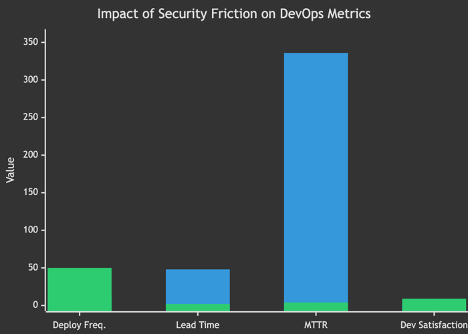
Figure 2.
A comparative bar chart based on hypothetical survey data. Two columns represent “Manual Security Gates” vs. “Platform-Embedded Security.” Metrics shown: Deployment Frequency (deploys/week), Lead Time for Changes (hours), Mean Time to Recovery, and Developer Satisfaction Score (1–10). The platform-embedded side shows higher deploy frequency, shorter lead times, and elevated satisfaction, illustrating the positive correlation between seamless security and performance.
3. Platform Engineering: The Golden Path to Secure Delivery
The effectiveness of Platform Engineering in securing the supply chain is grounded in the concept of the Golden Path—a curated, supported set of tools, configurations, and workflows that guide developers from idea to production with minimal cognitive resistance. In a security-first platform, the golden path is deliberately engineered to satisfy compliance and protection requirements by default.
From service inception, developers bootstrap new projects using platform-provided templates. These templates embed secure-by-default configurations: non-root container base images, read-only filesystems, pre-integrated logging and monitoring agents, network policies that deny all egress by default, and initial resource limits. This proactive stance eliminates entire classes of misconfigurations—like overly permissive IAM roles or exposed debug endpoints—that are commonly exploited in supply chain attacks.
As code moves through the CI/CD pipeline, the platform orchestrates security gates seamlessly. It runs static application security testing (SAST), dynamic analysis (DAST), secret detection, and software composition analysis (SCA) on every commit. Crucially, the results are surfaced directly in the pull request or developer portal, alongside build logs, offering immediate feedback rather than asynchronous email alerts. A developer who inadvertently commits credentials receives a blocking comment with remediation steps within seconds, allowing them to fix the issue without leaving their flow.
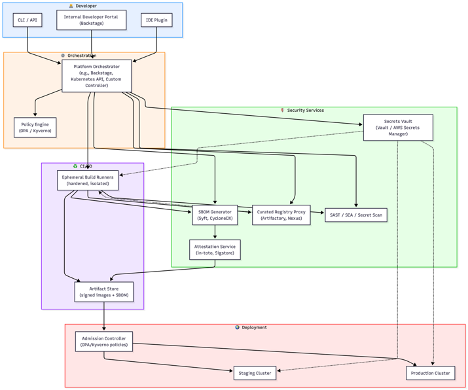
Figure 3.
A block diagram showing the developer interface (CLI, portal, IDE plugin) connecting to an orchestration layer (Backstage, Kubernetes API, custom controller). The orchestration layer enforces policies via OPA/Kyverno, delegates CI/CD to ephemeral runners, interacts with a central secrets vault, and generates SBOMs stored in an attestation service. The right side shows deployment environments (staging, production) with policy enforcement at admission control. Arrows indicate that all paths flow through security controls automatically, with no manual steps.
4. Key Mechanisms of Supply Chain Protection via Platform Engineering
This section details the core security capabilities a modern IDP should deliver, mapping each to specific supply chain threats.
4.1. Automated SBOM Generation and Provenance
Software Bills of Materials (SBOMs) have become a cornerstone of supply chain transparency, mandated by U.S. Executive Order 14028 and recommended by frameworks like SLSA (Supply-chain Levels for Software Artifacts). An IDP integrates SBOM generation as a non-negotiable step in the build pipeline, using tools such as Syft or CycloneDX generators. Every container image, library, and deployment artifact receives a signed attestation of its ingredients and build provenance (e.g., via in-toto or Sigstore). The platform indexes all SBOMs, enabling security teams to query, “Where is Log4j version x.y.z?” across the entire organization in seconds, vastly reducing MTTR during vulnerability outbreaks.
4.2. Policy-as-Code and Admission Control
Policy-as-Code (PaC) shifts security rules from written documents into executable code enforced by engines like Open Policy Agent (OPA) or Kyverno. The platform embeds these policies at multiple layers:
- CI checks: Reject pull requests that introduce critical vulnerabilities or unapproved base images.
- Artifact validation: Scans artifacts for high-severity CVEs before promoting to registries.
- Deployment guardrails: Kubernetes admission webhooks deny workloads that lack mandatory annotations (e.g., data classification), run as root, or violate network segmentation policies.
Because policies are version-controlled and tested like software, they provide consistent, auditable enforcement without relying on human review.
4.3. Ephemeral, Immutable Build Environments
Compromised build infrastructure is a prized target for attackers (e.g., the SolarWinds and Codecov incidents). A platform provisions ephemeral, hardened build runners that are destroyed after each pipeline execution. These runners are isolated from the public internet (using private package mirrors) and run with minimal privileges. The entire build environment—including compiler versions, dependency resolvers, and toolchain—is defined declaratively and reproduced from golden images, eliminating drift and unauthorized modifications.
4.4. Centralized Secret Management with Identity-Based Credentials
Developers often resort to hard-coded credentials or shared .env files, creating significant secret leakage risks. The IDP integrates with a centralized vault (HashiCorp Vault, AWS Secrets Manager, etc.) and issues short-lived, identity-bound credentials. A service receives a scoped token valid only for the duration of its deployment, obtained automatically via a sidecar or init container, eliminating the need for developers to ever touch a secret. Additionally, the platform scans repositories and builds for secrets, breaking the build if any are found.
4.5. Dependency Firewall and Curated Registries
Instead of pulling arbitrary packages from public registries, the platform interposes an internal artifact proxy (e.g., Artifactory, Nexus). This firewall caches approved versions, blocks those with known critical vulnerabilities, and enforces license compliance. Developers are forced onto the golden path because direct external access is network-restricted, and the internal registry is the only route to consumption. This practice effectively mitigates dependency confusion and typo-squatting attacks.
Table 1.
Traditional vs. Platform-Embedded Security Controls
|
Dimension |
Traditional Security Model |
Platform-Embedded Model |
|
Vulnerability Scan |
Quarterly manual audit |
Every commit, automated, in CI pipeline |
|
Dependency Approval |
Spreadsheet-based review |
Curated proxy with automatic policy enforcement |
|
Secret Handling |
.env files, manual rotation |
Short-lived, identity-based, zero-touch |
|
Compliance Evidence |
Auditor spreadsheets and screenshots |
SBOMs, attestations, and platform telemetry |
5. Cultural Transformation: From Gatekeeper to API-Driven Compliance
One of the most profound effects of platform-embedded security is the cultural shift it enables. In a traditional model, security functions as a gatekeeper, issuing tickets and blocking releases. This often breeds an adversarial relationship where developers view security as a hindrance. Platform Engineering reframes security as a product that is consumed via APIs and integrated into the developer’s natural workflow.
Compliance moves from a “ticket-based” model to an “API-based” model. Security posture is continuously measured through telemetry produced by the platform - build attestations, SBOMs, policy evaluation logs, and audit trails. Dashboards aggregated from this data provide real-time risk visibility to both developers and executives. A risk officer no longer needs to request a manual report; they can query the platform’s compliance API and instantly see the percentage of services running on the latest patched base image or the number of open critical vulnerabilities. This transparency builds trust and reduces the bureaucratic overhead that slows innovation.
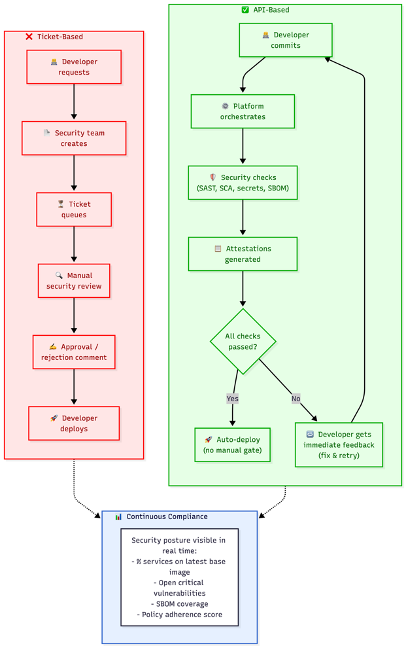
Figure 4.
Left side: “Ticket-Based” – a lengthy sequence of developer → security ticket → review → approval → deployment. Right side: “API-Based” - developer commits, platform executes automated policies, generates attestations, and if checks pass, automatically deploys. A dashboard shows continuous compliance posture to security and leadership without any manual steps.
6. Measuring Impact: Metrics and Industry Adoption
Organizations that have adopted security-embedded platforms report tangible improvements in both security posture and developer velocity. While specific figures vary, patterns include:
- Deployment frequency increases by 2–5× because security is no longer a manual bottleneck.
- Mean Time to Remediation (MTTR) for critical vulnerabilities drops from weeks to hours, thanks to instant SBOM queries and automated patching pipelines.
- Density of security findings in production decreases as misconfigurations are prevented by default.
- Developer satisfaction scores rise when security becomes transparent and supportive.
Companies like Spotify (Backstage), Netflix (Paved Road), and several global banks have publicly shared their journeys toward internal platform adoption, citing supply chain risk reduction as a primary motivator. The Gartner 2023 report on Platform Engineering underscores that by 2026, 80% of large software engineering organizations will have established platform teams to provide reusable services and components—with security being one of the top three drivers.
7. Implementation Challenges and Strategic Roadmap
While the benefits are substantial, implementing a security-embedded platform is not without challenges. A phased approach mitigates risk:
- Discovery and alignment: Identify the top three security pain points (e.g., secret leaks, dependency management) and ensure buy in from development, security, and operations leadership.
- Build the minimal viable platform: Focus on a single golden path and integrate automated SCA, SAST, and secret scanning. Use existing CI/CD infrastructure where possible.
- Curated registries and SBOMs: Introduce an internal artifact proxy and mandatory SBOM generation, refining policies iteratively.
- Policy-as-Code and admission control: Enforce policies in non-blocking “audit” mode first, then progressively tighten.
- Metrics, feedback loops, and culture: Expose dashboards, celebrate security champions among developers, and continuously gather feedback to reduce platform friction.
Potential pitfalls include over-engineering the platform too early, insufficient investment in platform team staffing (a small team can become a bottleneck), and failure to treat the platform as a product with its own roadmap and developer ergonomics. Addressing these through product management discipline and strong internal advocacy is critical to success.
8. Conclusion
Platform Engineering represents a definitive evolution in how organizations approach software supply chain security. By shifting away from reactive, manual security audits and toward the proactive delivery of secure, self-service platforms, enterprises can eliminate the friction that has long undermined both security and developer productivity. Embedding protection into the platform’s fabric ensures that security is omnipresent yet unobtrusive, transforming the golden path into a fortified highway for software delivery.
The integration of SBOMs, Policy-as-Code, curated registries, ephemeral build environments, and automated vulnerability management into an invisible developer experience is not merely a technical achievement—it is a strategic imperative. In an era of escalating supply chain threats, the most resilient organizations will be those that make security a property of the platform, not a checklist to be reviewed before a release. As the data and architectural patterns described here demonstrate, high-velocity innovation and high-integrity security are not trade-offs; they are mutually reinforcing outcomes of a well-architected internal platform. The future of secure software delivery lies in building-in security, not bolting it on—and platform engineering provides the optimal framework to achieve that at scale.
Список литературы
- Forsgren, N., Humble, J., & Kim, G. (2018). Accelerate: The Science of Lean Software and DevOps. IT Revolution Press
- Behr, A., Spafford, G., & Kim, G. (2016). The Phoenix Project: A Novel about IT, DevOps, and Helping Your Business Win. IT Revolution Press
- Gartner. (2023). Top Strategic Technology Trends: Platform Engineering. Gartner Research
- CNCF. (2024). Software Supply Chain Best Practices Guide. Cloud Native Computing Foundation
- NIST. (2022). Secure Software Development Framework (SSDF) Version 1.1. National Institute of Standards and Technology
- Davis, J., & Daniels, K. (2016). Effective DevOps: Building a Culture of Collaboration, Affinity, and Tooling at Scale. O'Reilly Media
- Kim, G., Debois, P., & Willis, J. (2021). The DevOps Handbook: How to Create World-Class Agility, Reliability, and Security in Technology Organizations. IT Revolution Press
- Skeptical, M. (2023). Software Bill of Materials (SBOM) and the Future of Supply Chain Transparency. IEEE Security & Privacy
- Ward, J., & Kavis, M. J. (2021). Accelerating Cloud Adoption through Platform Engineering. O'Reilly Media
- O'Reilly. (2024). Security-as-Code: Integrating Security into the CI/CD Pipeline. Technical Report
- Sonatype. (2023). 2023 State of the Software Supply Chain Report. Sonatype
- SLSA (Supply-chain Levels for Software Artifacts). (2023). SLSA Specifications v1.0. OpenSSF

